 TEXTILES.ORG




Mechanically stabilized earth (MSE) walls have been used in the United States since the early 1970s and earlier in Europe.
MSE walls are an earth retention system that is composed of granular backfill material, soil reinforcing, and a facing element. MSE walls were developed as an alternate construction technology to other gravity bottom-up construction methods such as concrete gravity or cantilever walls.
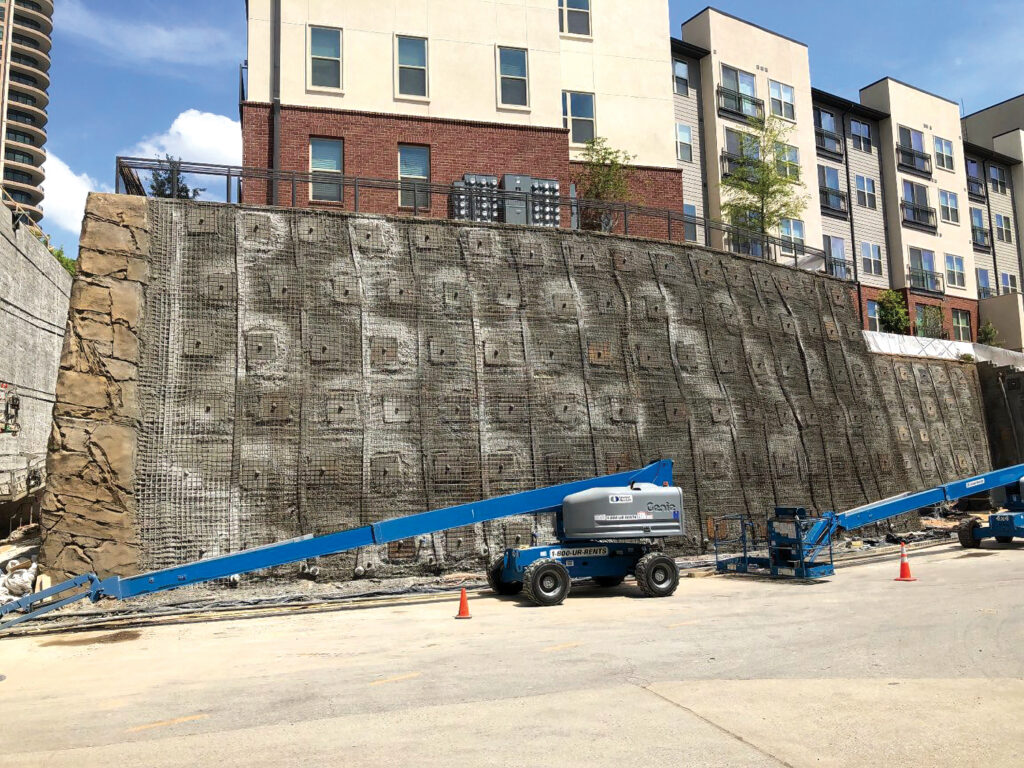
MSE wall alternatives presented faster and less expensive construction. They also had the added benefit of tolerating more flexibility which allowed MSE walls to reduce or eliminate the need for ground improvement which would add cost and complexity to the project. These benefits have made MSE walls the wall type of choice in many situations.
Early MSE walls used steel strip reinforcement, later expanding to welded steel bar mats. While steel remains the dominant reinforcement material, in the late 1980s and early 1990s, polymer geogrid reinforcement was introduced also bringing new facing types, connection methods and design considerations. As proprietary systems multiplied, it became increasingly difficult for owners to evaluate and approve new materials and designs.
To address this challenge, the Highway Innovative Technology Evaluation Center (HITEC) was established in 1994 to provide independent evaluations of MSE wall systems for state transportation agencies. Many Departments of Transportation relied on HITEC reviews when determining which systems to include on their approved products lists. After more than two decades, the program required modernization.
In 1994 engineers were comfortable utilizing traditional concrete structures and were hesitant to adopt new systems promoted by private manufacturers. In 2016 the use of MSE walls had evolved and become the wall type of choice in many applications. To reflect this shift, the Innovations, Developments, Enhancements, and Advancements (IDEA) program was created to replace HITEC. These programs served as unbiased means of communication between the private sector innovation and public‑sector implementation. IDEA continues this mission but with a more efficient philosophy.
The IDEA program is built on the premise that MSE walls are now well‑established, with standardized design and construction specifications. Instead of questioning if MSE walls work, IDEA focuses on evaluating how the components and systems behave within current standard practice. The reviews look at material testing, connection performance, design methodologies, construction procedures, detailing, quality control and historical performance. For geosynthetic‑reinforced systems, IDEA incorporates reinforcement testing data from the AASHTO Product Evaluation and Audit Solutions (PEAS) program. (Read more)
For owners, IDEA provides an independent, technically rigorous review of new research and system innovations. There are many areas of expertise involved in MSE wall development, such as corrosion science, polymer behavior and chemical durability, which extend beyond the typical knowledge base of agency engineers. IDEA evaluations bring in the necessary specialists and present findings in a consistent and familiar format. This reduces the level of effort required when considering a system for approval. It also helps ensure that decisions are based on reliable, unbiased information.
For the industry, these evaluations offer an independent and nationally recognized review of their system that many state DOTs already include as one of their submittal requirements. It is recognized that some states have additional requirements. This is unavoidable since every state is independent of each other. The IDEA report can be the baseline, allowing the suppliers to focus on the state specific supplemental requirements. The goal of the program is to help accelerate the deployment of new technologies and innovations.
For more information:
- https://www.geoinstitute.org/special-projects/idea
- https://geosyntheticsmagazine.com/2025/10/30/aashto-product-evaluation-and-audit-solutions/
- Design and Construction of Mechanically Stabilized Earth (MSE) Walls
- GEC 11
- FHWA-HIF-24-002
Daniel Alzamora, P.E., is a contributing editor for Geosynthetics and has spent more than three decades in the geosynthetics industry in both the public and private sector.